

The Outrage Economy Doesn’t Care What You Meant
What a Starbucks Korea tumbler promotion teaches marketers: a campaign can be innocent in intent, stupid in context and catastrophic in the real world. In an age of AI shortcuts, instant outrage and global screenshots, brands need a human cultural check before clever ideas become public apologies.
So this happened.
Starbucks Korea, the South Korean operator of the global coffee chain, launched a promotion for a large drinks tumbler called “Tank.” The campaign was called “Tank Day.” So far, so not so good.
Unfortunately, it launched on May 18, the anniversary of the 1980 Gwangju Uprising, when South Korea’s military government violently suppressed pro-democracy protesters.
You can already hear the brakes failing.
Critics connected “Tank” and “Tank Day” to the military vehicles used in the crackdown. They also connected campaign language about putting the tumbler on the table with a “tak” sound to a phrase associated with the 1987 torture death of student activist Park Jong-chol.
Within hours, the promotion was pulled. The CEO of Starbucks Korea was soon fired. Shinsegae Group, the South Korean retail conglomerate that operates Starbucks Korea, publicly apologized. Sales dropped. Government bodies distanced themselves. Starbucks Korea later announced it would close all stores early on one day in June for mandatory training on history and social sensitivity.
All for a tumbler.
Was the outrage fair. Of course not. Haters gotta hate. But I’ll leave that argument for comment sections, panel shows and people with too much time and very strong views about drinkware.
For marketers, PR heads and CEOs, the lesson is simpler and far less comforting. A campaign does not have to be malicious to become catastrophic. It only has to be interpretable. Starbucks did not need to mean harm for the harm to become real.
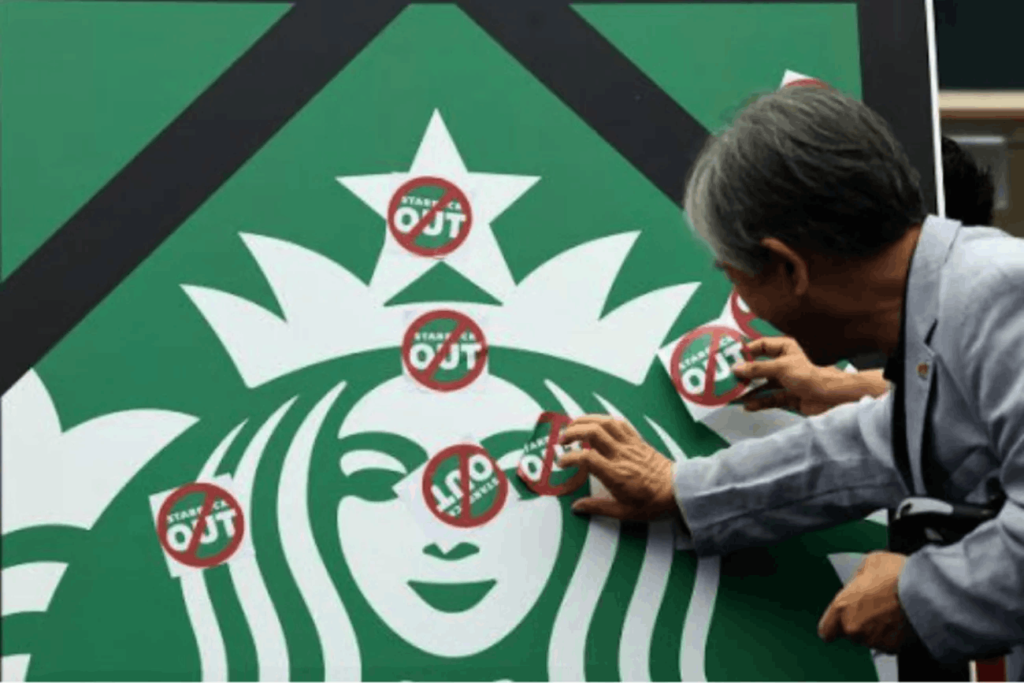
“We Didn’t Mean It” Is Not a Crisis Strategy
Starbucks said the incident was unintentional. Shinsegae reportedly found no evidence the campaign was deliberate. I believe that.
Inside the meeting room, “Tank” probably sounded like product language. Big. Solid. Durable. Heavy-duty. A tumbler with shoulders. “Tank Day” probably sounded like a neat retail mechanic. The launch date may have come from inventory timing, app scheduling or a promotional calendar. The slogan may have been intended as harmless product theater.
Nobody in the room was necessarily thinking, “How do we turn a coffee cup into a national wound?”
But that’s exactly the problem. Campaigns live in the real world, where dates have history, words carry baggage, images have echoes and people are very good at connecting dots. The dots in this case were brutal: Tank. Tank Day. May 18. Gwangju. State violence. A global brand. A slogan that critics tied to another ugly chapter of Korean history.
This is the part marketing people often hate, because we still cling to the fantasy that intent matters most. It does not. Not once activists, consumers, politicians, journalists and bored internet prosecutors concoct a narrative.
The outrage economy is not a courtroom. It does not need proof in any real sense. It needs symbols, timing, screenshots and a villain. And nothing makes a better villain than a large brand explaining that it did not mean to do the thing everyone is furious about.
AI Is Not the Adult in the Room
AI didn’t cause the Starbucks Korea crisis. Reporting says Shinsegae claimed marketers consulted an AI tool for the campaign slogan. Reporting also says some managers who approved the campaign had not opened the attachments showing the materials. This suggests AI may have been somewhere in the chain while humans failed to do the one job AI cannot be trusted to do: understand what an idea may awaken in a specific culture at a specific moment.
And let’s be honest. It is increasingly hard to believe that many campaigns today do not pass through AI somewhere. Naming routes. Copy options. Translations. Search prompts. Social captions. Internal summaries. Research shortcuts. Headline drafts. “Just give me ten options.” “Make it punchier.” “Any issues with this?”
The problem is not that marketers use AI. Everyone is using AI somewhere, in some form, whether officially, quietly or through the intern who is now mysteriously 400% more productive.
The problem is treating AI like judgment.
AI can generate options. It can produce a lot of words very quickly. It can summarize, translate, polish and imitate confidence beautifully. What it cannot reliably do is know when a perfectly ordinary phrase becomes toxic because of history, memory, grief, politics, language, timing or local trauma.
At best, AI is a brilliant intern. It is not the grown-up in the room. Not yet.
And if the grown-ups are approving campaigns without opening the attachments, then the chatbot is not the weakest link in the chain. The chain is the weakest link in the chain.

Context Hijacks Campaigns
Starbucks Korea is not the only brand to discover that a campaign can become about something it was never intended to be about.
Zara, the Spanish fashion retailer owned by Inditex, pulled campaign images in 2023 after critics said visuals of wrapped mannequins, rubble and damaged-looking figures resembled images from the Gaza war. Zara said the campaign had been conceived earlier and was intended to show a sculptor’s studio.
That may be true. It also did not matter. The campaign did not have to be about Gaza to become about Gaza.
This is what marketers need to understand. Context is part of the campaign. If the world changes between concept and launch, the campaign needs to change with it. A fashion shoot can become a war image. A product name can become a historical insult. A slogan can become evidence. A model choice can become a geopolitical statement. A joke can become a boycott.
Localization Is Not Cultural Intelligence
There is a lazy version of global marketing that believes every risk can be solved by localization. Translate the copy. Swap the model. Change the currency. Add local hashtags. Maybe use the right flag emoji if no one gets sleepy. Welcome to our world.
But localization asks whether the campaign fits the market. Cultural intelligence asks what the campaign could awaken.
Swatch, the Swiss watch brand, apologized in 2025 after an ad showing an Asian male model pulling the corners of his eyes triggered backlash in China and calls for boycott. The company removed the material globally and apologized for the distress or misunderstanding caused.
Again, perhaps someone saw fashion mischief. A pose. A face. A moment. A little visual attitude. The audience saw a racist gesture with a long history.
The most dangerous campaigns are often not the ones everyone knows are risky. Those get reviewed, debated, legally cauterized and PR-proofed until they have the pulse of a dentist’s waiting area. The dangerous ones are the ones that look harmless to the people in the room. Which is why the people in the room are often the problem.

“People Are Overreacting” Is Not a Plan
Whenever one of these controversies explodes, someone immediately says, “People are overreacting.” Often, they’re not wrong.
Sometimes outrage is sincere. Sometimes it is performative. Sometimes it is political. Sometimes it is opportunistic. Sometimes it is twelve people on X, three journalists, two politicians and a brand team having a nervous breakdown in real time.
But commercially, that distinction is not as useful as people think. Once the backlash is moving, the brand does not get to stop the train by explaining that the passengers are being unfair.
Adidas, the German sportswear company, revised a 2024 campaign for its SL72 sneaker after criticism over the shoe’s connection to the 1972 Munich Olympics, where Israeli athletes were murdered by Palestinian militants. The campaign featured Bella Hadid, an American model of Palestinian heritage. Adidas said the connections were unintended.
Again, I can see how this happened. Retro shoe. Global model. Fashion image. Campaign calendar. Nice lighting. Someone probably thought it looked great.
But the public saw 1972 Munich, Israel, Palestine, Bella Hadid and a German brand. Suddenly a sneaker campaign had become a political statement.
Whether Adidas meant that statement is almost beside the point.
The Numbers Don’t Care About Your Intent Either
YouGov found that more than seven in ten consumers across 17 international markets said they would boycott a brand if the company or its leaders acted in ways they objected to. In the UAE and Saudi Arabia, YouGov found that 66% of consumers said they had temporarily or permanently boycotted a brand following a scandal.
Kantar’s Brand Inclusion Index found that 75% of consumers say a brand’s diversity and inclusion reputation influences purchase decisions. McKinsey found that 88% of surveyed organizations regularly use AI in at least one business function, with marketing and sales among the most common areas of use.
So we have three forces colliding. Consumers are more willing to punish brands. Brands are producing more content, faster, across more markets. AI is increasingly embedded in the machinery of that production. What could possibly go wrong?
Everything, obviously.
Speed Makes Stupidity Scalable
AI did not invent bad judgment. Marketing departments were perfectly capable of producing stupid ideas long before anyone asked a chatbot to “make this more premium but playful.”
What AI does is make speed feel like intelligence. It can produce a hundred lines in the time it used to take one human to stare out the window and have one useful thought. It can generate campaign names, social captions, slogan routes and localization options with impressive confidence and absolutely no fear of being fired.
And because the output looks finished, everyone starts behaving as if thinking has happened. More output is not more judgment. Sometimes it is just more rope.
Every Campaign Needs a Kill Switch
The answer is not timid marketing. God save us from safe campaigns. Most of them deserve to die quietly in the procurement department.
Brands should still be bold, funny, provocative, fast, strange, distinctive and occasionally dangerous. But bold is not the same as oblivious. Provocative is not the same as handing critics a loaded gun and a Wi-Fi connection.
Every campaign now needs a kill switch. Not a bureaucratic committee that makes the work worse by sanding off anything interesting. Not a late-stage legal review. A real kill switch. Someone with the cultural competence and organizational authority to stop the campaign before it becomes a case study.
That means asking, before launch:
- What date are we launching, and what does that date mean in this market?
- What do the words mean in local slang, politics, history and minority communities?
- Do the visuals resemble current news images, tragedies or conflicts?
- What is the most hostile good-faith interpretation?
- What is the most opportunistic bad-faith interpretation?
- Where did AI touch the work?
- Who reviewed it with actual cultural knowledge?
- Did the approvers actually open the materials?
- What would the headline be if this went wrong?
Those of you who know me, know that last one is my favorite. I often start from the headline and work backwards. It cuts through almost everything. If you cannot bear the headline, do not launch the campaign.
The Adult in the Room
Modern agencies are not just here to make brands more visible. The role of a serious marketing and PR partner is not to say yes more elegantly. It is to ask the irritating question before the public asks it louder. It is to protect the idea from itself. It is to see the second meaning before the internet gives it a lawyer, a hashtag and a moral position.
The adult in the room is not there to ruin the work. The adult is there to stop the work from ruining the company.
Starbucks Korea did not fall to its knees because of a tumbler. It fell because a product name, a campaign name, a date, a slogan, possible AI involvement, unread approvals and national memory collided in public.
Maybe the outrage was excessive. Maybe it was opportunistic. For marketing directors, PR heads and CEOs, that debate is secondary. The outrage economy does not care what you meant.
So. before the campaign goes live, find the adult in the room. And make sure it is not the chatbot.
Sources: Reuters — Starbucks Korea to give staff history training after backlash over marketing campaign; Reuters — Starbucks Korea head fired after “Tank Day” promotion sparks public uproar; Reuters — Shinsegae chairman public apology and reported sales impact after Starbucks Korea backlash; The Guardian — How Starbucks Korea’s “Tank Day” marketing stunt spiralled into mass boycotts; Reuters — Zara pulls campaign after Gaza boycott calls and later expresses regret over “misunderstanding”; The Guardian / People — Adidas apologizes and revises Bella Hadid SL72 campaign linked to 1972 Munich Olympics; Reuters — Swatch apologizes for “slanted eye” ad after backlash in China; YouGov — Global brand boycott survey across 17 markets; YouGov — UAE and KSA consumers boycotting brands following scandals; Kantar — Brand Inclusion Index 2024; McKinsey — The State of AI