Dead or Alive: AI Is Giving Celebrity Endorsements an Afterlife
Greta Garbo is selling magnetic bearings. José Mourinho is arguing with himself. Heidi Klum is appearing alongside her younger self. Welcome to advertising’s new talent pool, where age, geography—and increasingly death—are becoming optional.
We were probably resurrecting celebrities before it was cool. Many years ago, we created an outdoor campaign for Marriott, the global hotel company, in the US using stills from old Laurel and Hardy films. Stan Laurel and Oliver Hardy were the legendary comedy duo whose films made them among the most recognizable performers of the first half of the 20th century.
No AI. No generative video. No digital humans. Just two very dead comedians, some very funny photographs and the quaint old-fashioned process known as getting permission. Acquiring those rights from the comedians’ estates is a long story involving a famous clown. That story will have to wait for another day. [Or, buy me a beer and ask me about Bozo.]
The important point is that advertising has always understood that fame has a shelf life considerably longer than the famous person. What we were doing was essentially the low-tech version of something advertising can now do at industrial scale.
Cue Greta Garbo.
Garbo Wanted to Be Alone. AI Had Other Plans.
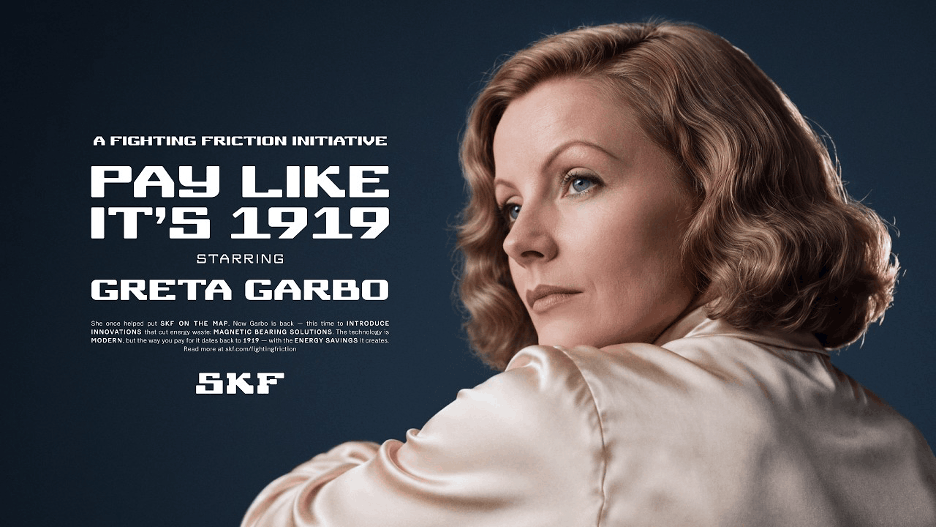
Recently, The New York Times reported that SKF, the Swedish industrial manufacturer best known for bearings and other technologies that reduce friction in machinery, had put an AI-generated Greta Garbo to work selling frictionless magnetic bearings.
Garbo, the Swedish-American film star who became one of Hollywood’s greatest icons before abruptly retiring from acting in 1941 and dying in 1990, had an unexpected historical connection to the company. As a young actress, she appeared in a film used to promote Swedish industry abroad.
SKF worked with Garbo’s family and licensing representatives. Her new visual performance was created with generative AI software capable of creating new images, video, voices or other content from instructions and data while authorized archival audio helped recreate her voice.
That makes this much more interesting than a cheap deepfake stunt. It is authorized, historically connected and technologically sophisticated—and people still found it creepy. SKF has wandered into a much larger argument that advertising is going to have whether it wants to or not.
If you can bring virtually anybody back to advertise virtually anything, who should you bring back. And more importantly, should you?
This is not some speculative question for 2035. According to the Interactive Advertising Bureau, or IAB, the US trade organization representing the digital advertising industry, 83% of advertising executives now say their companies have deployed AI somewhere in the creative process, up from 60% in its 2024 study.
The dead are arriving at a rather busy party.
The Celebrity Is Becoming Software
Garbo may be one of the more provocative examples, but she isn’t an isolated curiosity. In barely two years, brands have begun turning celebrities, athletes, television personalities, influencers and fashion models into reusable digital assets. That is the larger advertising story.
Celebrity endorsements traditionally sell access to a human being: their face, voice, personality, credibility and cultural currency. But access is expensive, finite and inconvenient. Famous people have schedules. They age. They live in particular places. They speak particular languages. They can only shoot so many commercials.
AI begins separating the value of the celebrity from the physical presence of the celebrity. The result is increasingly something called a digital twin: an authorized synthetic representation of a real person that can reproduce aspects of that person’s appearance, voice or behavior and be used to create performances the original person never actually made.
For CMOs, that’s far more consequential than simply making production cheaper. It changes what they are buying.
Avocados From Mexico, the nonprofit marketing organization that promotes Mexican avocados in the US, demonstrated the shift around the 2025 Super Bowl with former American football star Rob Gronkowski, universally known as “Gronk.”
Instead of merely putting the four-time Super Bowl champion in another commercial, the organization created an AI version of him for its “Guacline.” Consumers could conduct two-way conversations with a synthetic Gronk using generated video and voice.
He wasn’t simply appearing in an advertisement. He was available for a chat.
The celebrity spokesperson has gone from broadcasting at the audience to answering back.
And the advertising business is moving in that direction remarkably quickly. In 2025, IAB found that 85% of digital-video advertising buyers were either already using or planning to use generative AI to create or enhance video advertising.
You Don’t Need the Celebrity Every Time You Need the Celebrity
The economic significance becomes clearer when AI stops being the idea of the campaign and simply becomes part of how the campaign gets made.
Betr, an American sports-betting and sports-media company co-founded by professional boxer and social-media personality Jake Paul, used an authorized AI version of Paul’s image and voice for a national commercial.
The extraordinary part isn’t the digital Jake Paul. It’s the production economics.
The commercial was produced in roughly 48 hours using AI advertising technology from Waymark, a US company specializing in automated video production. Waymark said comparable conventional production could have involved around 12 weeks of work and a budget of $100,000 to $500,000.
Jake Paul didn’t have to go to the shoot. Jake Paul didn’t even have to exist at the shoot.
This is where CMOs should start paying attention. Because once an approved digital version of the talent exists, the question changes from When can we get Jake back in front of a camera? to What else can we make Jake do?
IAB estimated that 30% of digital-video advertising creative was already being created from scratch or enhanced using generative AI in 2025, with buyers expecting that figure to reach 39% in 2026.
You Can Even Endorse Things With Yourself
AI doesn’t just make celebrities reproducible. It can make them temporally flexible.
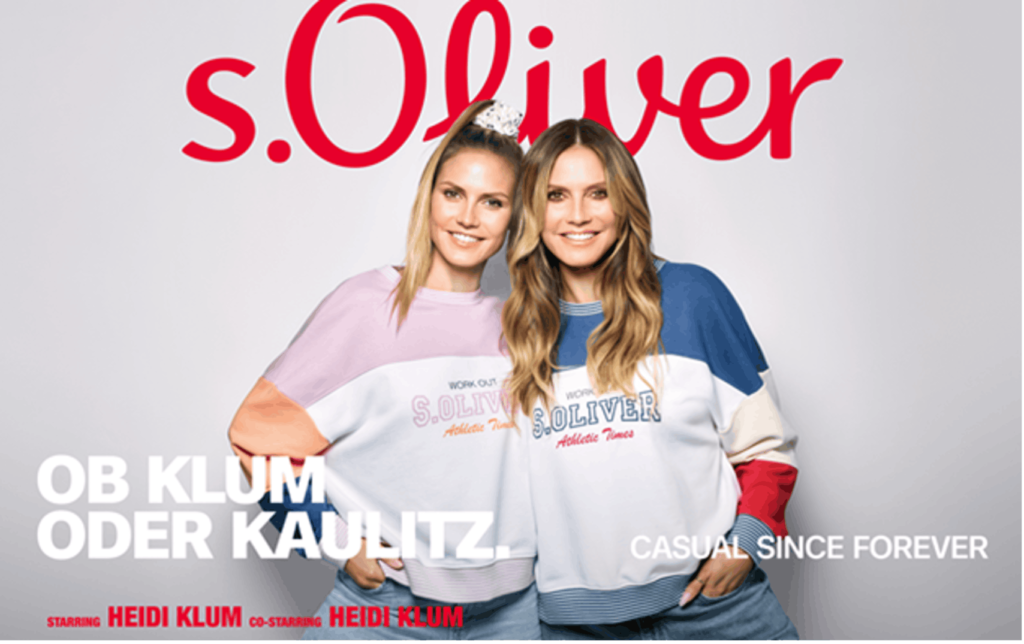
In September 2026, s.Oliver, the German fashion brand known for casual clothing, put Heidi Klum, the German-American supermodel, television host and producer, face-to-face with an AI-created version of her younger 1990s self.
The campaign, Casual Since Forever, uses the encounter to dramatize the longevity of both Klum’s style and the brand itself.
That is a much better use of the technology than simply shouting: Look! Two Heidis! The technology serves a brand thought.
The talent can now exist at several ages simultaneously. For the first time, a celebrity can plausibly compete with her younger self for screen time. The celebrity spokespersons’ version of the multiverse, if you’re a sci fi fan.
Archives no longer have to remain archives. An old photograph, voice recording or body of work can become source material for entirely new performances.
The person becomes less like a piece of talent and a little more like intellectual property with great bone structure.
One Celebrity. Two Opinions. No Scheduling Conflict.
Coca-Cola, the global soft-drink company, took the idea further during the 2026 FIFA World Cup with José Mourinho, the Portuguese football manager famous both for winning major championships and for having unusually strong opinions about practically everything.
Working with Footballco, the global football-media company behind brands including GOAL, Coca-Cola created an authorized AI-powered digital twin of Mourinho. Then it effectively split him in two.
In José vs. Mourinho, two versions of Mourinho argue opposing sides of football debates in social content created throughout the tournament.
This is more than reproduction. It is character multiplication. An authorized model of that person can create entirely new situations built around recognizable elements of their personality.
The only person capable of interrupting José Mourinho more effectively than José Mourinho is apparently another José Mourinho.
The campaign was designed to generate more than 200 pieces of content, distributed through GOAL across major social platforms.
For a global marketer, that begins to look less like celebrity advertising and more like a celebrity-powered content engine.
Fame Is Becoming Variable Data
The really disruptive possibility is not making the same advertisement faster. It is making thousands of different versions of it.
Traditional celebrity campaigns are inherently one-to-many. The celebrity films something once; millions of people see essentially the same performance.
AI can start turning that model inside out.
Vaseline, the skincare brand owned by global consumer-goods company Unilever, created an AI avatar of Febby Rastanty, an Indonesian actress and social-media influencer, for its #BebasHealing campaign in Asia.
The digital version of Rastanty could personally greet consumers and invite them into the promotion. Instead of merely delivering a mass-market endorsement, she became part of a personalized experience. The campaign reached more than 71 million people, increased brand sales by 15% and generated promotional sales 29% higher than previous Vaseline promotions. That’s not an AI demo. That’s marketing doing its job well.
Now Your Spokesperson Can Interview Herself
The most interesting applications tend to be the ones in which the technology itself has something to say.
Absa, one of Africa’s largest banking groups, created FifiAI, a digital version of Fifi Peters, a prominent South African financial journalist and broadcaster.
The AI representation was developed using verified information about Peters, her career and extensive interviews with her. Absa then put the real Peters in an unscripted conversation with her artificial counterpart.
The concept worked because the campaign was exploring something larger: the distinction between what data can know about a human being and what actually makes that person human. The AI clone was therefore not decoration. It was the argument.
The best AI celebrity work doesn’t say, “Look what the machine can do.” It gives the machine a reason to be there. Technology is not an idea. It simply gives a good idea more ways to misbehave.
Models Are Becoming Licensed Media Assets Too
This change will not stop with celebrities.
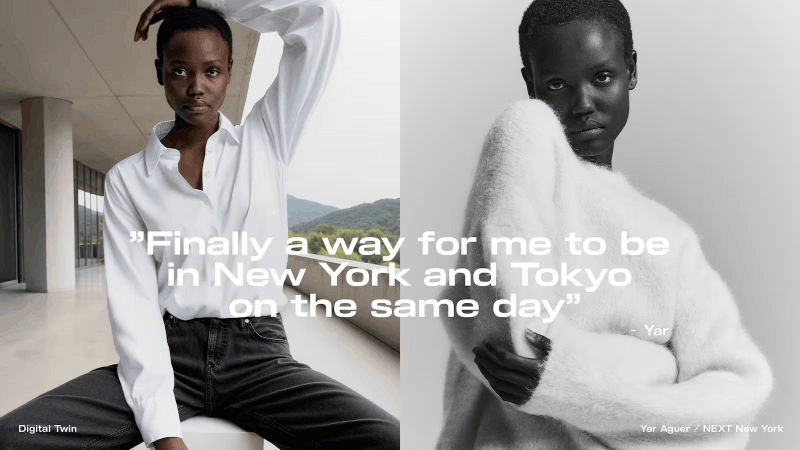
H&M, the Swedish global fashion retailer, began creating authorized AI “digital twins” of real fashion models in 2025 and released its first campaign images featuring them that July. H&M has said that the models retain rights over their digital likenesses, which means the synthetic version potentially becomes another asset they can license commercially rather than simply a technological replacement that eliminates them.
For advertisers, the implications are enormous.
A fashion model might work in Paris while her licensed digital twin simultaneously appears in an approved campaign in Tokyo. A celebrity might approve twenty localized advertisements without shooting twenty advertisements. A global campaign might adapt talent across formats and markets without repeatedly reassembling the people, sets, crews and schedules involved in the original production.
And we are still early. Research from SAS, the global data and AI software company, found in 2025 that only 5% of marketers were experimenting with digital twins, while investment in generative AI more broadly was racing ahead.
Very early. Which, as every marketer knows, is approximately three weeks before everyone claims they have been doing it for years.
The Celebrity Can Become an Interface
NBCUniversal, the American media and entertainment company behind television networks, film studios and the Peacock streaming service, has created a generative-AI avatar of Andy Cohen, the American television host and producer closely associated with its Bravo reality-television network.
The avatar guides users through Peacock’s personalized “Bravoverse,” an AI-driven viewing experience built from more than 5,000 hours of Bravo programming.
The synthetic Cohen isn’t merely appearing in an advertisement. He’s helping people navigate the product.
At that point Andy Cohen isn’t really the spokesperson anymore. He’s part of the user interface.
The logical endpoint of celebrity endorsement may not be a better commercial. It may be an approved digital personality that can recommend, explain, demonstrate, entertain, sell and interact with consumers whenever they want.
NBCUniversal says the system behind the Bravoverse can produce more than 600 billion possible viewing variations.
A spokesperson used to have a media schedule. Now the spokesperson can become media.
Even the Shoot Is Becoming Optional
The physical production itself is also shrinking.
IM8, a nutritional-supplement brand co-founded by former English football star David Beckham and health-sciences company Prenetics, created a 2025 Times Square campaign featuring Aryna Sabalenka, the Belarusian professional tennis player who has been ranked No. 1 in the world and won multiple Grand Slam singles titles.
The producer described the finished work as approximately 95% AI and 5% real footage. That percentage may be more interesting than the advertisement.
For most of advertising history, the question after filming was: What can we make from everything we shot? Increasingly the question may become: How little do we actually need to shoot?
That does not mean eliminating photographers, filmmakers, actors or production companies. It means the raw material they create can potentially travel much further.
Garbo Is Where All These Roads Meet
What makes the Greta Garbo campaign significant isn’t merely that Garbo is dead. It’s that generative AI has dramatically lowered the barrier between an archive and a new performance.
SKF didn’t simply reuse old Garbo footage. It generated a Garbo capable of doing something Greta Garbo never did: pitching today’s technology in today’s advertising.
That is fundamentally different from what I did with Laurel and Hardy. I took an existing performance and gave it a new context. SKF created a new performance from a person who could no longer give one.
And unlike the unauthorized celebrity “deepfakes”—realistic but fabricated images, audio or video depicting someone doing something they never actually did—that proliferate online, Garbo’s family and licensing representatives participated in and approved the project. That’s the distinction CMOs should tattoo somewhere discreet.
Permission Is Not the Same Thing as Good Judgment
There are really three questions here, and marketers should resist the temptation to collapse them into one.
Can we do it? That’s a technology question.
May we do it? That’s a rights question involving contracts, estates, likeness rights, voice rights, copyright, performers’ agreements and the laws of the countries in which the work will appear.
Should we do it? That’s a marketing question. And it’s the most important one.
Garbo demonstrates that even an authorized resurrection can make people uncomfortable.
IAB found in 2026 that 82% of advertising executives believed Gen Z and Millennial consumers felt positively about AI-generated advertising. Only 45% of those consumers actually did.
An estate’s signature can give you permission to resurrect somebody. It cannot make the resurrection charming. Sometimes too real is the problem.
Audiences know Greta Garbo didn’t discuss data-center bearings. They know there aren’t actually two José Mourinhos arguing with each other. They know 1990s Heidi Klum didn’t travel through time for s.Oliver. The fiction works when the audience willingly participates in it.
That gives marketers a useful principle: Don’t use AI to fool people into believing something happened. Use it to invite them into something they know couldn’t have happened. Heidi meeting Heidi: interesting. Mourinho arguing with Mourinho: funny. A synthetic celebrity presented deceptively as an authentic performance: potentially creepy.
And younger consumers may be less forgiving than marketers assume. IAB found that 39% of Gen Z consumers felt negatively about AI-generated advertising, almost twice the 20% among Millennials.
The audience most accustomed to synthetic media may not necessarily be the audience most impressed by it.
The Economics Are About to Become Irresistible
Traditional celebrity advertising has four stubborn constraints: availability, production, geography and mortality. Synthetic celebrity removes or reduces all four.
One approved human performance—or eventually one properly licensed digital model—can potentially become different languages, different products, different markets, different retailers, different scripts, different formats, personalized executions and interactive experiences. Without ten more shoots.
This is why treating AI merely as a production-cost story badly understates what is happening. A conventional endorsement buys a piece of a celebrity’s time. An AI-era endorsement may increasingly license a system capable of generating performances. Those are very different economic propositions.
Because saving money is a perfectly sensible reason to use technology. It is a terrible reason to make bad advertising faster.
Before You Dig Up Anybody Famous
The technology is moving faster than most companies’ judgment around it. A useful discipline is therefore not a giant AI rulebook but five fairly brutal questions.
The relevance test: Is there a genuine reason this person belongs with this brand?
The permission test: Do you control every necessary likeness, voice, performance and territorial right?
The authenticity test: Would the person plausibly have agreed?
The disclosure test: Would knowing how it was made improve or damage the idea?
The creative test: If you remove the AI gimmick, is there still an idea?
That last one may be the most important. Because “Look! We made Einstein sell insurance!” is not an idea. It is a software demonstration with a media budget.
Nobody Retires Anymore
When I used Laurel and Hardy, the photographs already existed. The performances had already happened. We were giving old material a new context. Today a brand can create a performance that never existed by a person who no longer exists. That’s a fundamentally different creative power—and responsibility.
Laurel and Hardy couldn’t say anything new for Marriott. Greta Garbo now can.
Soon celebrities won’t merely leave behind films, photographs, recordings and endorsement rights. They’ll leave behind models: licensed digital selves capable of performing new scripts, in new languages, for new audiences, perhaps forever.
Which means death may finally have met the one industry shameless enough to regard it as a production inconvenience: Advertising.
Sources: The New York Times — Greta Garbo / SKF, Reuters — Greta Garbo / SKF, IAB — The AI Ad Gap Widens, IAB — Digital Video Ad Spend & Strategy, Avocados From Mexico / Fast Company — Rob Gronkowski / Guacline, Adweek — Jake Paul / Betr, s.Oliver — Heidi Klum / Casual Since Forever, Coca-Cola / Footballco — José vs. Mourinho, WARC — Vaseline / Febby Rastanty, Absa — Fifi Peters / FifiAI, H&M Group — Digital Twins, NBCUniversal — Andy Cohen / Bravoverse, MediaPost — IM8 / Aryna Sabalenka, SAS — AI marketing research