

Marketing Is a Loaded Gun. Let’s Stop Giving It to Idiots.
Good marketing can build a company. Bad marketing can humiliate it, cost millions, destroy partnerships and get senior executives fired. So why do we keep repeating our mistakes?
Thank goodness there is never any shortage of bad marketing and bad marketers for us to learn from.
Good Good did BAD BAD by setting fire to their own reputation.
Good Good Golf is a US golf-entertainment and lifestyle company that began as a YouTube collective in 2020. A group of young golf personalities built an audience with energetic golf challenges, competitions and comedy. They then turned that audience into a substantial business selling branded clubs, clothing and accessories, producing television content and securing major partnerships with Callaway, the golf-equipment manufacturer, and the PGA Tour, America’s principal professional golf circuit.
In other words, they should have known better. Good Good had raised $45 million, attracted more than 2.1 million YouTube subscribers and generated an estimated $40 million in annual revenue. Then it placed the whole enterprise in jeopardy with a video lasting less than one minute.
The advertisement promoted a Good Good-branded Callaway driver, the long club used for tee shots. Good Good co-founder Garrett Clark sees fellow creator Alexis Miestowski approaching his golf bag, charges at her, violently shoves her to the ground, stands over her and warns her not to touch his club. Clark performs it with all the nuance of an arrogant prick in a student film – and not enough acting ability to make it clear he is supposed to be playing one.
The concept was allegedly inspired by Obsession, a horror film about violent possessiveness. Unfortunately, the advertisement was neither scary nor funny. It was simply a badly conceived, poorly executed and terribly acted depiction of a man assaulting a woman over a golf club.
And this stuff actually ran. Check it out here.
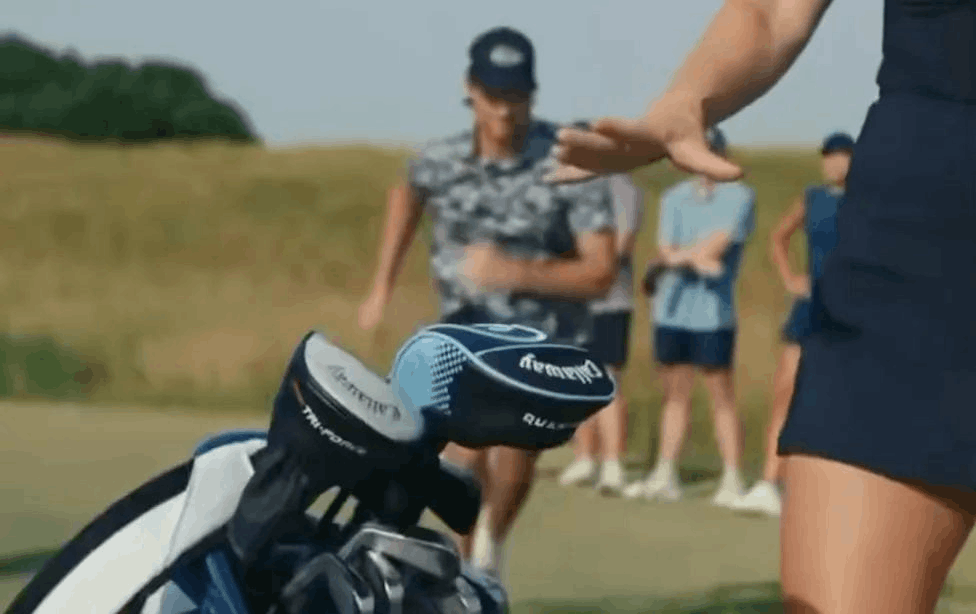
The video was removed, but the internet had already done what the internet does. Callaway ended the partnership. Major retailers removed Good Good products. Golf Channel cancelled its program. Good Good surrendered its title sponsorship of a PGA Tour event. Its vice president of brand and marketing was fired, another marketing employee disappeared, Callaway’s content director departed and Good Good’s chief executive and president subsequently left the company. Not bad for 56 seconds of content. Imagine what they could have destroyed with a full media plan.
Curiously, Garrett Clark was not among them. The co-founder who performed the shove remained with the company and continued creating content. In his apology, Clark even presumed to speak ‘on Good Good’s behalf and on Good Good marketing team’s behalf’; shortly afterwards, marketing employees and senior executives were shown the door while he kept his seat. Having pushed a female colleague to the ground, he then appeared to push other staffers under the corporate bus. So we probably haven’t seen the last stupid idea from this moron.
A Loaded Gun in the Hands of marketing toddlers
Marketing is one of the few corporate functions capable of placing a stupid idea in front of millions of people before lunchtime. Yet companies increasingly hand it to inexperienced content creators, deferential agencies, junior social-media team, oh, and arrogant co-founders, and then act astonished when somebody pulls the pin.
Usefully, Good Good has given us an almost perfect diagram of the corporate approval farce. Its marketing team created the advertisement. Callaway’s marketing team approved it. The performers acted in it. A production crew filmed it. Editors cut it. People on both sides presumably watched the finished film. Apparently, the only person who didn’t get a vote was somebody with common sense.
Good Good’s then chief executive, Matt Kendrick, said he had not seen the advertisement before it was published. That is an explanation, not an exoneration. A CEO should not approve every Instagram post, but he is responsible for putting in place marketing leadership who build a system capable of identifying a man knocking a woman down as a potential concern.
This isn’t the first time you’ve heard me say that every campaign needs an adult in the room who owns the final decision. Consensus spreads responsibility so thinly that nobody feels responsible at all. Kantar, a global marketing-data and research company, calculates that creative quality contributes nearly 50% of advertising’s media impact, far more than reach or frequency. Bad creative therefore does not merely waste the production budget. It contaminates every media dollar placed behind it.
Permission Slipped Through Spam
Of course, Good Good Golf is just one example. AI music company Suno recently provided another useful demonstration of what happens when enthusiasm overtakes basic administration. Suno, which allows users to generate songs from written instructions, released an advertisement showing Mary J. Blige apparently praising an AI-generated track that imitated the Grammy-winning singer’s musical style.
The problem was not simply that audiences disliked the endorsement. Blige had not approved it. Suno said it had entered into an agreement with someone falsely claiming to represent her and terminated the campaign once it discovered the problem. It remains unclear how the company obtained the footage used in the advertisement.
Apparently, confirming that a global recording star’s representative genuinely represents her was considered an optional administrative detail. It is difficult to imagine a company in a more sensitive category making a less reassuring mistake. Suno sells technology already accused by musicians of imitating artists without permission, then advertised itself using an artist it apparently had not properly secured permission to use. That’s not just irony. That’s a business model tripping over its own shoelaces.
Verification is not paperwork standing in the way of creativity. If a campaign depends upon a person, quotation, endorsement, license or factual claim, establish that it is real before telling the world about it. Kantar and WARC, the advertising-effectiveness company, found that the most creative and effective advertisements generated more than four times as much profit as weaker work.

Influence Without Authenticity
OpenAI, the artificial-intelligence company behind ChatGPT, tried a more luxurious route to borrowed credibility. It invited business and career influencers – social-media personalities whose perceived authority comes from their relationship with their followers – to a retreat near New York called Summer Club. There were scenic views, hospitality and monogrammed pajamas, because nothing says independent technological inquiry like sleepwear with your initials on it.
The objective was to humanize OpenAI and educate creators about artificial intelligence. Instead, the resulting posts reportedly attracted limited engagement and criticism about AI’s effects on employment, creativity and the environment. The influencers looked less like independent voices discovering a technology and more like paid guests enlisted to soften the image of a controversial industry.
Influencers are not magical credibility dispensers. If the audience can see the transaction more clearly than the idea, the campaign becomes an advertisement for its own insincerity. US advertisers are expected to spend $44 billion on creator marketing in 2026, around 18% more than in 2025. That is an extraordinary amount of money to invest in rented personalities without demanding a defensible strategy underneath them.
The lesson is not to avoid influencers. It is to stop treating their audiences as transferable property. Their credibility works only when the subject, setting and message feel natural to them. Put them in matching PJs at a corporate retreat and they may still produce content. What they cannot manufacture is belief.

Lost in Translation, With a Drum
Lululemon, the Canadian athletic-wear company, staged a yoga and cultural event on the Great Wall to celebrate its tenth anniversary in mainland China. Chinese actor Zhu Yilong joined what was presented as a traditional Chinese drum performance, but critics said the instrument, staging and playing style resembled Japanese taiko, the large barrel-shaped drums used in Japanese performance.
At a moment of heightened tension between China and Japan, a campaign intended to honor Chinese culture managed to suggest that an international brand could not distinguish it from somebody else’s. Lululemon apologized and removed related content. When the company later reduced its annual forecast, its shares fell approximately 18% in extended trading. Broader product and sales problems drove that decline, but executives still cited negative reaction to the Great Wall campaign as one contributor to weakness in China.
Localization requires more than hiring a local celebrity and translating the press release. If a campaign celebrates a culture, someone who deeply understands that culture must have veto power over it. Local expertise is not there to sprinkle authenticity over a finished foreign idea. It is there to prevent the foreign idea from becoming an international incident.
Approved by Whom?
Ghanda Clothing, an Australian fashion retailer, faced boycott calls over images in its Surfco catalogue that critics said unnecessarily sexualized young female models instead of selling the clothing. More than 1,100 protest emails were reportedly sent to the company as the campaign grew.
Ghanda defended the work by saying it complied with advertising standards and had been approved by Australia’s advertising watchdog. The watchdog then said it had never provided the claimed prepublication approval. The brand did not merely misjudge the imagery. It attempted to outsource responsibility to an authority that said it had never cleared the work. A competent marketing department should aspire to something slightly higher than not being prosecuted.
The Idiot Test
Good Good’s catastrophe didn’t require sophisticated cultural analysis. Nobody needed AI-powered sentiment modelling, a global risk committee or a forty-page brand-safety manual. Someone simply needed to watch the finished advertisement and ask: ‘Are we really showing a man smashing a woman to the ground because she touched his golf club?’
That is the uncomfortable lesson underneath all these examples. Most bad marketing is not destroyed by some obscure sensitivity detectable only in hindsight. It fails questions that should have been asked in the room:
- What does the advertisement literally show?
- What is the worst reasonable interpretation?
- Does it contradict the brand’s values or history?
- Are we borrowing pain, identity or social purpose we haven’t earned?
- Who represented in the work has reviewed it?
- Can every excerpt survive without its surrounding context?
- What current event could make this grotesquely inappropriate?
- Has one senior person been given authority – and accountability – to stop it?
- Are we defending the idea because it is good, or because too much money and ego have already been invested?
- Would we be comfortable explaining it on television after the backlash begins?
Marketing is enormously powerful. That is precisely why it should never be entrusted to people whose principal qualification is knowing how to upload a video.
Sources: Business Insider, August and September 2026; Front Office Sports, August 2026; Forbes, June 2026; Good Good Golf company announcement, March 2025; Entertainment Weekly, September 2026; The Verge, August 2026; The Guardian, April and June 2026; Reuters, August and September 2026.