



Google Lied to Your Dashboard for a Year.
For fifty weeks, the world’s most trusted marketing measurement tool was quietly reporting fantasy numbers. The real scandal isn’t that it happened. It’s that nobody noticed — and absolutely nobody should be surprised..
I read about Google’s Search Console data scandal and felt that very specific sensation familiar to anyone who has spent serious time in this industry: not shock, not outrage, but a kind of weary, knowing recognition. The feeling you get when something you suspected for years is finally confirmed in writing.
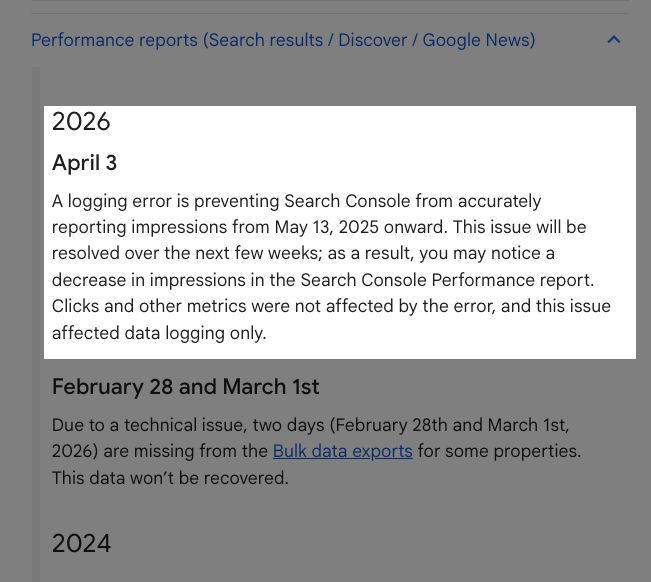
A 47-word changelog entry, buried on a data anomalies page that nobody reads, quietly admitted that Google had been over-reporting search impressions for every website on the planet for fifty consecutive weeks. No email. No announcement. No apology. The SEO community spotted it before Google said a word.
I’ve seen this before. We all have. The platforms that built empires on marketers’ trust have a long and distinguished history of grading their own homework, then handing it back with a gold star. We kept accepting the grade. We called it being data-driven. We put it in board presentations. We made hiring decisions based on it. Agencies were fired over it.
Which is precisely why, in our PR for Robots series — where we track the shift from traditional search to AI-powered visibility — we keep returning to the same point: the digital metrics religion has been asking you to worship a god with a well-documented habit of making things up.
What Actually Happened
Between May 13, 2025 and April 27, 2026 — fifty weeks — Google Search Console was systematically over-reporting impressions in its Performance report. Every website. Every market. The entire tool, broken, for nearly a year.
Clicks were unaffected. Impressions were inflated. Which means every CTR calculation your team produced during that period used a wrong denominator, making your click-through performance look worse than it was. Every visibility trend line showing “growing impressions” may have been measuring the growing bug, not growing reach. Every board report, every agency presentation, every strategy document built on Search Console impressions was, to some degree, built on fiction. And given that DemandScience’s research across 750 senior marketing leaders found that 25% of the average marketing budget is already being spent on efforts that look productive in metrics but don’t drive outcomes, the Google bug didn’t create the waste. It just added to it.
Google has since fixed the logging error going forward. What it will not do is reconstruct the historical data. Fifty weeks of corrupted numbers are now permanent. They are the foundation of decisions already made, budgets already spent, strategies already locked in.
The disclosure, in full: “A logging error is preventing Search Console from accurately reporting impressions from May 13, 2025 onward.” Forty-seven words. For eleven months of bad data affecting every marketer on earth. You’re welcome.
This Is Not An Isolated Incident
If you are tempted to treat this as a one-off technical embarrassment, consider what else has happened recently and quietly.
On January 26, 2026, Meta deprecated all 10-second video metrics, a benchmark thousands of brands and agencies had used for years to evaluate video performance, with no direct replacement announced. Years of comparative data, rendered useless overnight. Whatever your video strategy was benchmarked against no longer exists as a measuring stick.
Instagram, across 2025 and into 2026, switched its primary metric from Impressions to Views, redefining what the number on your dashboard actually counts. Historical comparisons are now broken by design. Every trend line you drew crosses a definitional cliff edge you may not have noticed.
And underneath all of it, a structural rot that never left: $63 billion in global digital ad spend was wasted last year on invalid traffic — bots, click farms, automated scraping and non-human interactions that will never become a customer. That figure comes from Lunio’s 2026 Global Invalid Traffic Report, built on analysis of 2.7 billion paid clicks. If you think your website traffic at least tells you something real, NP Digital’s research across 602 tracked websites found that 51% of traffic came from bots and 21% were sessions too short to register anything meaningful. Sixteen percent, one in six visits, could be classified as genuinely engaged.
Your dashboard is full. Your funnel is largely empty.
The platforms are not being malicious. They are being something almost more dangerous: indifferent. Metrics change because products change. Errors get fixed when someone eventually notices. The marketing budgets built on top of those metrics are not their problem. They are yours.
“Data-Driven” Became A Religion.
Here is the real indictment, and I say this as someone who has spent over four decades watching this industry evolve: we let the word “data-driven” do the work that thinking used to do.
It became a shield. It ended conversations. It silenced instinct and experience in rooms where instinct and experience were exactly what was needed. If the numbers said it, it was true. If the platform reported it, it was real. We outsourced our judgment to dashboards and called it rigor. Today, 75% of marketers say measurement is broken. That’s not a fringe view. The Interactive Advertising Bureau, the industry trade organization that sets standards and best practices for digital advertising, included it in their State of Data 2026 report. And yet, 66% of senior marketing leaders simultaneously admit their campaigns frequently look successful in metrics while failing to drive revenue. We built a system sophisticated enough to produce the illusion of performance, and then we congratulated ourselves for reading it.
Nobody asked whose data it was, how it was counted, or what commercial incentive the platform had to make the numbers look healthy. Nobody asked because asking felt unscientific. Unmodern. The kind of thing someone who didn’t understand digital would say.
The Google bug didn’t create this problem. It just made it impossible to ignore for one more news cycle, before everyone updates their anomaly annotations in GA4 and moves on.
The Pivot That Changes Everything
There is, buried in all of this, something that resembles good news, if you’re positioned to see it.
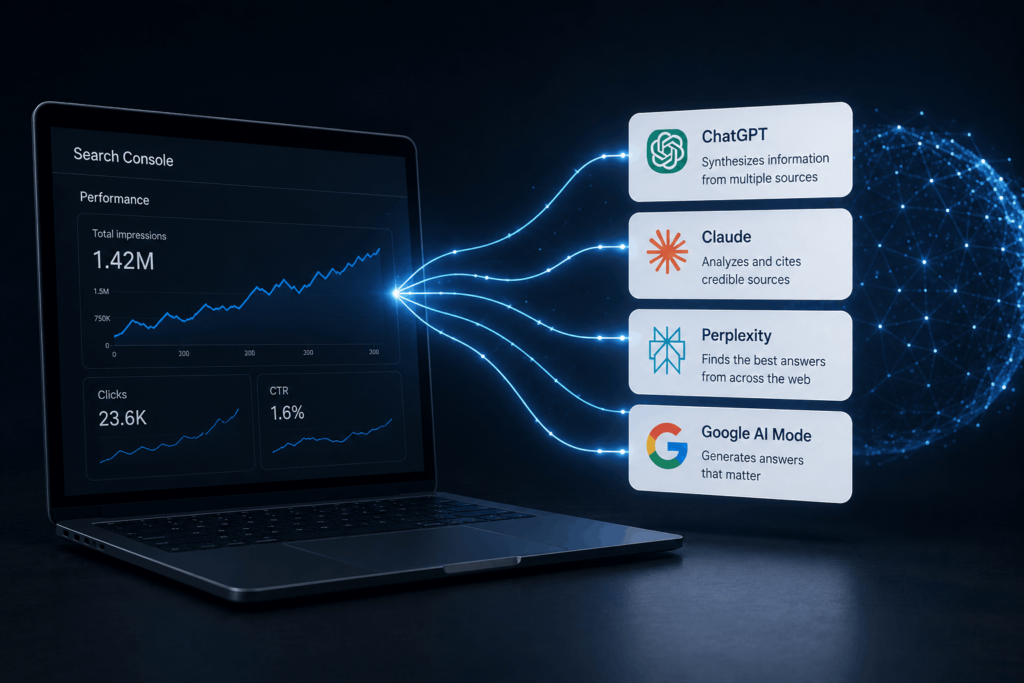
AI search doesn’t care about your impression count. ChatGPT, Claude, Perplexity, Google AI Mode and their expanding cohort don’t surface answers because your Search Console metrics looked healthy last quarter. They synthesize, they cite, they answer. The currency in AI search is authority, demonstrated expertise, genuine usefulness and earned trust — qualities that are considerably harder to inflate and considerably harder for a platform to accidentally break for fifty weeks without anyone noticing.
As we’ve been covering in PR for Robots, the brands that will win in AI search are the ones investing in being genuinely worth citing — not the ones optimizing for a metric that may or may not be accurately reported on any given Tuesday.
In a perverse way, the collapse of confidence in traditional digital measurement is the most compelling argument we have for taking AI search seriously now, before the same gaming, the same bot inflation and the same self-serving metric redefinitions arrive there too. Because they will. They always do.
What You Should Do This Week
Stop using impressions as a proxy for anything in a board conversation. They have been inflated, redefined and gamed too many times to carry the weight you’ve been placing on them.
Audit every performance target that was set using data from May 2025 to April 2026. You were measuring with a broken instrument. The targets need resetting.
Triangulate everything. Never rely on a single platform’s self-reported data. Cross-reference Search Console with Google Analytics 4, with third-party tools, with actual revenue. If the only source confirming your success is the platform you’re paying, that is not confirmation. That is a conflict of interest.
And start understanding AI search visibility now — before its measurement frameworks get captured, gamed and quietly disclosed in 47-word changelog entries too.
Finally
The platforms will keep changing their metrics, retiring benchmarks and disclosing year-long errors in language designed to be found by no one. That’s the deal. That’s always been the deal. We just chose not to read it.
The marketers who survive the next decade won’t be the ones with the cleanest dashboards. They’ll be the ones who never confused the map for the territory — and who understood early that in AI search, the territory just changed completely.
Sources: Google Search Console Data Anomalies Page, confirmed April 3, 2026; Search Engine Land, May 5, 2026l Lunio 2026 Global Invalid Traffic Report; DemandScience: The 2026 State of Performance Marketing, 750 senior leaders, October 2025; IAB State of Data 2026; NP Digital website traffic analysis, 602 properties, 2026; Meta Business Help Centre, January 26, 2026