

The Brief Is Still the Problem. AI Just Made It Worse.
We used to suffer from marketing briefs that were too short, too vague and too lazy. Now we’re getting briefs that are too long, too precise and often disconnected from reality. This isn’t a complaint (ok, is a little), but a spotlight on why the modern brief is getting worse, why great work gets locked out before it begins and how to fix it, including practical tips, a general brief structure and an AI prompt you might actually use.
I’ve said it before and I’ll probably (definitely) say it again: Most bad marketing is perfectly executed against a terrible brief.
Before AI, the terrible brief tended to be a small, sad creature. Two pages. Half a thought. “Drive awareness.” “Target everyone.” “Do something disruptive.” It arrived like a hungover intern: late, smelly and not especially helpful.
Now the bad brief has had a glow-up.
It arrives looking as though its author has just completed an executive education program…but didn’t exactly finish at the top of their class. Ten pages. Fifteen pages. Beautifully structured. Impressively thorough. Full of frameworks, tone ladders, audience matrices, strategic pillars, channel considerations, measurable outcomes and sentences that sound as if they were polished by a committee of consultants.
But then we start to read it.
Somewhere around page two, after the fifth objective, the third target audience and the second mention of being both “premium and accessible,” you realize nobody in the room actually knows what the brief is asking for. Not really. Not the person who pretended to draft it. Not the person who approved it. Not the people circulating it.
That’s the new problem. The companies distributing these briefs often do not fully know what they really say. But they sound, as we say in my hometown of Boston: smaaaaat. And in modern corporate life, sounding smart can be alarmingly close to being mistaken for thinking.
AI didn’t create that instinct. It just turned it into a production system. Adobe’s 2025 research found that 96% of marketers have seen content demand at least double in the last two years, 62% say it has increased fivefold or more and 71% expect it to grow by more than five times again by 2027. Under that kind of pressure, the temptation to generate something polished, comprehensive and allegedly strategic becomes irresistible. Why not let AI write the brief? We let it write everything else.
So yes, the brief is still the problem. AI just made it worse.

We didn’t fix the brief. We industrialized it.
The old problem was absence. Now the problem is excess. Every audience segment included. Every objective listed. Every deliverable requested. Every KPI promised. All neatly packaged, not always aligned and often not fully interrogated.
The workplace is already drowning in this sort of performance. Asana’s 2025 Anatomy of Work research says knowledge workers spend 60% of their time on “work about work” rather than skilled or strategic work. That is a fantastic phrase because it captures exactly what many briefs have become: work about strategy, rather than actual strategy.
You can see what clarity looks like by contrast in how Unilever has been actively simplifying its brand portfolio and cutting complexity to improve marketing effectiveness, which is not about writing better briefs but about making fewer, sharper decisions before the brief is written.
The irony is that better work still tends to start with fewer, sharper choices. The Canadian and American industry briefing guide, The Client Brief, puts it in blunt terms: “rubbish in equals rubbish out”, and stresses the need to define the current brand status, the market context, the key problem and the overall business objective. It should not include every dream objective the client has ever had since “Gangnam Style” was #1 in the charts.
AI writes what you ask. Not what you need.
AI is very good at producing what looks like a complete brief. It is less effective at judgment, trade-offs and saying no. It will happily produce a document that asks you to be premium and mass, disruptive but safe, global but deeply local, emotionally resonant but universally scalable, youth-oriented but reassuring to legacy customers, conversion-driven but brand-building and somehow faster, cheaper and more distinctive at the same time.
In other words, it gives form to indecision.
That is dangerous because indecision dressed as sophistication is much harder to challenge than the old bad brief. The old one was obviously lazy. The new one looks industrious. The old one limped into the room. The new one glides.
You can see the opposite discipline in how Amazon uses narrative memos internally, which are designed to force decisions rather than accumulate options, highlighting exactly what AI-generated briefs tend to avoid.
And yet the market is getting less forgiving, not more. McKinsey noted in 2024 that in developed markets over a third of consumers have tried different brands, about 40% have switched or added retailers to their regular rhythm and 60% think private label products are as good as or better than branded ones. That is not a market that rewards fuzzy thinking.
The rise of the impressive but unusable brief
A lot of AI-generated briefs now suffer from a very specific disease: they are polished enough to survive internal review and vague enough to fail in the real world.
This is where the problem stops being theoretical. The brief becomes a kind of ceremonial object. Nobody wants to admit they don’t understand parts of it. Nobody wants to ask which objective matters most because that might reveal that no such decision was made. Nobody wants to say, “This is contradictory nonsense in a tasteful font.”
And then it lands on the agency’s desk. That’s where the real damage begins.
Because once the brief has been circulated, it becomes politically difficult to change, operationally difficult to challenge and creatively difficult to reinterpret. Suddenly the agency is not solving a problem. It is obeying a document, which is exactly how organizations like HSBC end up repeatedly repositioning globally when central clarity is missing.
Fixed audiences. Fixed messages. Fixed deliverables. Fixed timelines. Then the client says, “We really want the agency to bring bold thinking.” That’s not a brief. That’s a set of instructions with a creativity rider.
The UK’s IPA (Institute of Practitioners in Advertising) says it plainly: a written brief is important, but not sufficient, and the briefing meeting matters. World Federation of Advertisers (WFA) recommendations on the pitch-process goes further, recommending initial chemistry meetings before a creative or media pitch to compare working styles and ethos. In other words, the grown-ups have been trying to tell us for years that the document alone is not the job.
What good looks like is already happening — just maybe not in your brief
I’m not sure what the briefs looked like for any of these campaigns, or if there was even a formal brief at all, or where the agency came into the process. But there must have been some level of clarity and freedom to think. Work like this doesn’t come out of convoluted, over-engineered documents.
Take Nike’s “Nothing Beats a Londoner.” It wasn’t built on a long list of deliverables or messaging layers. It worked because it captured a simple, sharply defined truth about youth identity in London. You don’t land that with a bloated brief, you land it when the problem is clear enough to inspire.
McDonalds’s “Raise Your Arches” campaign stripped branding back to its most minimal signal, the golden arches themselves, because the brand role was already understood. That level of confidence doesn’t come from over-specifying the work. It comes from clarity about what matters and what doesn’t.
When Tourism Australia launched “Come and Say G’Day,” it leaned into distinctive national personality rather than generic destination marketing. That only works when the brief, or the thinking behind it, defines what makes the place unique instead of listing everything it offers.
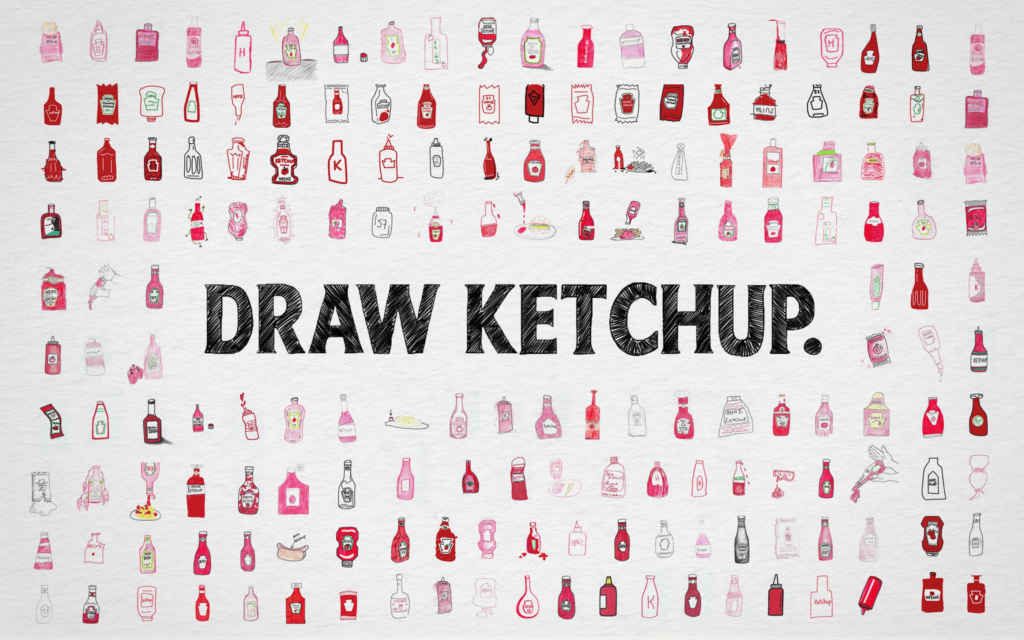
Heinz’s “Draw Ketchup” campaign where people instinctively sketched the Heinz bottle worked because the brand’s distinctiveness was already clear. You don’t brief that by listing features. You brief it by trusting what people already know.
Even more functional categories follow the same pattern. Apple’s “Shot on iPhone” platform is built on a single, obvious product truth. Volvo’s long-standing focus on safety continues to drive its communications globally.
Different sectors, different markets, different objectives but the same underlying condition: There is a clear problem. There is a clear idea. And there is enough space for the agency to do something with it.
Which is exactly what most modern briefs, especially AI-generated ones, are starting to destroy. They try to answer everything upfront. They remove ambiguity instead of shaping it. They confuse completeness with clarity. And in doing so, they leave no room for the very thing they are supposed to enable: thinking.

Why this matters even more now
Because audiences are not sitting politely still while marketing departments workshop their strategic prose.
PwC’s 2025 Middle East consumer findings show that 47% of regional consumers have used local retailers in the past year versus 45% globally, and 38% prefer local retailers for daily and weekly shopping versus 34% globally. In the same report, 44% said price was among their top food-selection factors, 36% prioritized taste and 34% brand trust. That is not a simple audience.
You can see brands responding intelligently to that nuance in how McDonald’s adapts menus and messaging across markets such as India and the Middle East, reinforcing the point that real-world complexity cannot be handled by generic briefs.
Edelman’s 2024 Brands and Politics report found that 60% of people buy, choose or avoid brands based on politics, and 78% say they will not buy foreign brands because of the country the brand is headquartered in. That is a brutally specific constraint that generic global briefs routinely ignore.
Kantar’s Media Reactions research adds another useful warning. In 2024, only 48% of people said humor made them most receptive to advertising, with music at 47% and story at 42%. That means format matters. Tone matters. Context matters. These are not afterthoughts to be added in slide twelve.
DeepL’s localization research found 96% of respondents reported positive ROI from localization and 65% reported ROI of 3x or greater. That is the market telling you, politely but firmly, that one-size-fits-all briefs are not efficient. They are expensive.
The solution is still the same. It just matters more now.
Get the agency involved before the brief is finalized. Not after. Before.
That is still the top tip because it was always the top tip. The difference is that AI has now made it even easier for internal teams to lock in bad assumptions inside beautifully formatted documents. By the time the agency sees it, half the strategic mistakes have already been laminated.
If you want great work, stop treating agencies like vendors who receive instructions and start treating them like partners who can help define the problem.
There should be a meeting with the agency in advance of the brief for input. If it is a pitch, there should be a meeting with each agency separately, not all together, because that inhibits the very questions you most need them to ask. Then there should be another meeting once the first draft of the brief exists, to clarify points, answer questions and remove contradictions before work begins.
Don’t be arrogant. Don’t waste agency time. These are your partners, not your vendors — that is…if you want great work.
A few more tips, because some of this is fixable
Keep the brief short enough that a busy intelligent person can actually read it and remember it.
Choose one primary objective and maybe one secondary one.
Describe the decision you need to influence, not just the message you want to say.
State the real constraints only.
Say what the audience currently believes and what you need them to believe.
If you are using AI, use it to structure and challenge, not decide.
What an ideal marketing brief actually looks like
Of course, every brief should be different because every brand challenge is different and terminology varies across markets and companies. But there is a basic framework.
- the business problem — the core issue you are trying to solve, in plain business terms
- the commercial objective — the specific outcome you need to achieve (revenue, growth, share, etc.)
- the audience — the precise group of people who must change behaviour
- what they believe now — the current perception or behaviour that is holding you back
- what you need them to believe or do — the shift in perception or action required
- the proposition — the single, clear idea or promise you are putting forward
- the proof — the evidence, product truths or reasons to believe the proposition
- the constraints — the real limitations (budget, timing, legal, mandatory elements)
- the markets — where this applies and how markets differ if relevant
- the measures of success — the one or two metrics that define success
- the unanswered questions — what is still unclear and needs discussion before proceeding
A better AI prompt for generating a brief to a marketing agency
Most AI-generated briefs today don’t fail because they lack information. They fail because they lack judgment. The prompt below is designed to fix that. It forces clarity, prioritization and, critically, creates space for the agency to think, challenge and contribute before being handed a fully locked set of instructions masquerading as strategy. Just fill in the blanks for a workable first draft.
“Act as a senior marketing strategist preparing a first-draft brief for a [creative / integrated / PR / media / branding / digital / experiential] agency. Your job is to create a concise, decision-focused agency brief that helps the agency think, not just execute.
Company: [insert company name]
What we do: [insert plain-English description]
Category: [insert category]
Markets in scope: [insert markets]
Business problem: [insert real problem]
Commercial objective: [one primary, one secondary max]
Audience: [specific description]
Current belief: [what they think now]
Desired belief: [what we need them to think or do]
Proof: [why they should believe us]
Brand guardrails: [what must stay true]
Cultural nuances: [specific realities]
Mandatory elements: [must include]
Constraints: [real limitations]
Success metrics: [1–2 only]
Unknowns: [what needs discussion]
Instructions:
keep under 2 pages
force prioritization
identify contradictions
separate strategy from deliverables
flag where agency input is needed
end with five questions the agency should ask
One final brief point
The brief should be where creativity is born. Increasingly, it is where creativity is smothered. The good news is that the cure is not mysterious. Decide more. Write less. Involve the agency earlier. Because the best briefs do not impress. They inspire.
Sources: Adobe for Business, Asana, McKinsey, PwC, Edelman, Kantar, DeepL, IPA, ACA, Campaign Middle East, Agoda press materials, World Federation of Advertisers